When the Safety Net Becomes the Ceiling: How a Fallback Career Can Cap Your Creative Potential

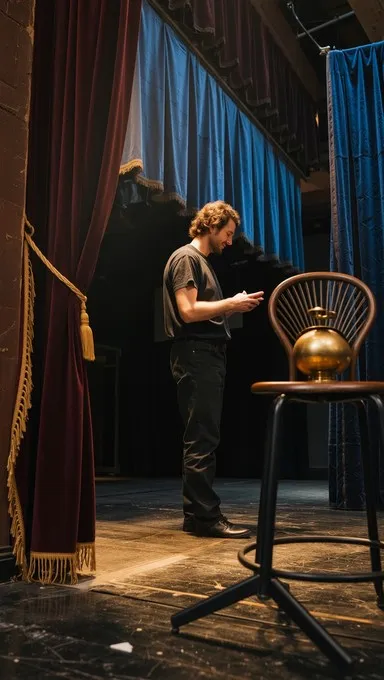
Photo by Photo by Luis Morera on Unsplash on Unsplash
The Comfort That Costs You
There is a version of security that protects you and a version that merely pacifies you. For performing artists navigating the financial uncertainty that defines so much of this life, the line between the two is rarely obvious. A second income stream feels responsible. A teaching position on the side feels sensible. A corporate fallback feels like wisdom. And in many cases, it is. But there is a particular species of backup plan — the kind you carry not as a bridge but as a destination — that does something insidious to the work you claim to be protecting.
It teaches you, slowly and without fanfare, that you don't actually have to go all the way.
This is not an argument against financial intelligence. Artists who cannot eat cannot create. The romanticization of destitution has done real damage to real careers, and no serious performer should confuse martyrdom with commitment. But there is a meaningful distinction between a practical arrangement that funds your primary work and a psychological escape hatch that quietly reorders your priorities without ever announcing itself.
The question worth sitting with is not whether you have a Plan B. It is whether Plan B has started making decisions for Plan A.
What Divided Attention Does to the Work
Performance, at its most demanding, requires a quality of presence that cannot be partially rendered. Audiences — particularly American audiences, who are sophisticated consumers of entertainment and increasingly attuned to the difference between someone going through the motions and someone genuinely on the line — register the difference between a performer who is fully invested and one who is managing their exposure.
That management is subtle. It does not look like indifference. It looks like polish without edge. It looks like competence without risk. It sounds like a voice that is technically proficient but never quite breaks open. It manifests in the choices an artist makes when facing a creative crossroads: the safer interpretation chosen over the revelatory one, the conventional structure favored over the formally ambitious one, the familiar emotional register selected over the one that requires genuine excavation.
These choices accumulate. Over time, they constitute a body of work that is accomplished but not transformative — and in a landscape as competitive and crowded as American entertainment, accomplished without transformative is a difficult place from which to build a lasting career.
The Performers Who Crossed the Line
The history of American performance is populated with figures whose breakthroughs arrived not after careful strategic positioning but after a moment of terrifying, irreversible commitment. Stories abound — in theater, in music, in film — of artists who spent years producing capable, well-reviewed work and then, following some form of surrender to the uncertain path, produced something that changed the terms of the conversation entirely.
What changed was rarely the talent, which had been present all along. What changed was the relationship to consequence. When the fallback was removed — by circumstance, by choice, or by the simple exhaustion of maintaining two parallel lives — the work became the only available container for everything the artist had been carrying. The result, in case after case, was a quality of urgency and authenticity that no amount of careful preparation had previously produced.
This is not a pattern that recommends recklessness. It is a pattern that recommends honesty about what the backup plan is actually doing.
Strategic Diversification Versus Psychological Fragmentation
Not all supplementary income is created equal, and this distinction matters enormously. There is a form of diversification — teaching master classes, consulting, licensing creative work — that extends naturally from an artist's primary identity and actually deepens engagement with the core craft. A working actor who teaches scene study is not fragmenting their commitment; they are metabolizing it, sharpening their analytical relationship to the work by articulating it for others.
The arrangement that tends to do damage is the one that exists in a separate psychological universe — the career kept on standby that requires its own emotional maintenance, its own professional identity, its own set of ambitions and contingencies. That kind of backup plan does not simply consume time and energy, though it does both. It maintains, at the center of the artist's self-concept, the live possibility of becoming someone else. And that possibility, however rarely examined, shapes every creative decision made in its presence.
The performing artist who knows, at some level, that they can step back into a previous life at any moment is not the same performer as the one for whom this work is the only available reality. The stakes are different. The choices are different. The work is different.
Navigating Financial Reality Without Surrendering Artistic Integrity
The practical challenge, of course, is that full commitment to an uncertain creative path carries genuine risks that cannot be wished away. Rent is real. Health insurance in the United States is a serious and ongoing concern for independent artists. The gig economy of performance work is structurally designed to keep practitioners in a state of managed precarity.
The answer is not to pretend these realities do not exist. The answer is to structure the practical arrangements of one's life in ways that support the primary commitment rather than quietly competing with it. This means being ruthlessly honest about which supplementary activities reinforce your artistic identity and which ones gradually replace it. It means setting specific, time-bounded parameters around secondary income work rather than allowing it to expand indefinitely into the space your primary work requires. It means treating the question of commitment not as a one-time declaration but as a practice — something examined and renewed regularly, particularly at moments when the creative path becomes most demanding.
It also means recognizing that the psychological work of full commitment — the internal act of removing the escape hatch — can precede the practical act of doing so. An artist who has genuinely decided that this is the only path available to them will make different choices even while the backup plan technically remains in place. The decision is not always circumstantial. Sometimes it is simply a choice.
What the Work Requires of You
The deepest creative work tends to demand, at some point, an accounting. It asks what you are willing to risk, what you are willing to surrender, and whether you are genuinely present or merely visiting. These are not comfortable questions, and the presence of a comfortable alternative makes them easier to defer.
The understudy, by definition, is always prepared to step in but never fully in. There is nothing wrong with being an understudy — it is a legitimate and demanding professional role. But the artist who approaches their own primary work with an understudy's psychology — ready, capable, waiting for the circumstances to become more certain before fully inhabiting the part — may find themselves perpetually in the wings of their own career.
The front of the stage is available. The question is whether you are willing to occupy it completely.