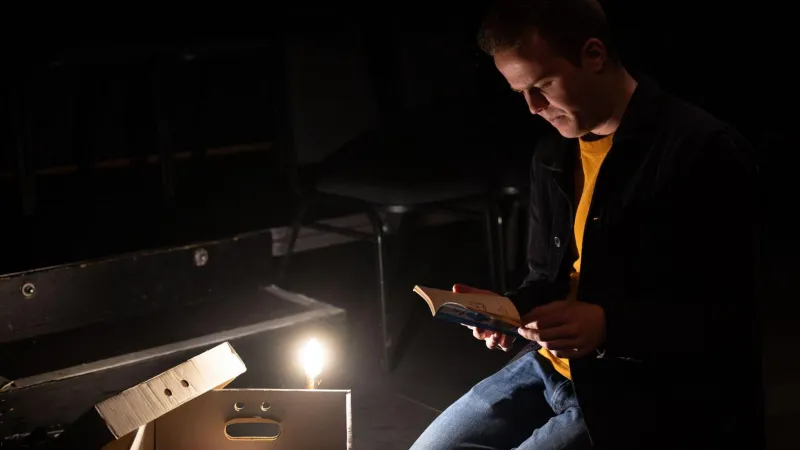
The Exit Strategy That Sets You Free: How Mapping Every Escape Route Makes You Bolder on Stage
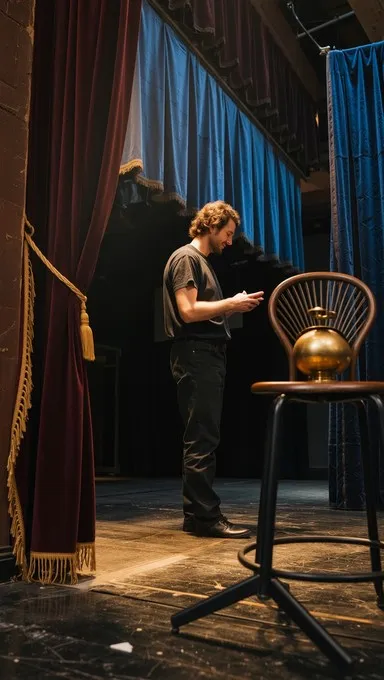
Photo: performer backstage preparing alone theater wings dramatic lighting, via images.stockcake.com
I have stood in a parking lot behind a converted warehouse in rural Ohio, watching the venue's entire sound system flicker and die forty minutes before showtime. I have walked into a corporate event expecting three hundred guests and found thirty. I have been handed a microphone that cut in and out like a bad cell signal throughout an entire forty-five-minute set. And in every one of those moments, the same internal compass steadied me—not courage, not bravado, but preparation so thorough that failure had already been rehearsed.
This is what I have come to call the understudy mindset: the deliberate, almost obsessive practice of readying yourself for every version of the night that is not the one you planned for.
The Paradox at the Center of the Stage
Conventional wisdom about performance tends to romanticize spontaneity. We celebrate the artist who appears to live entirely in the present tense, unencumbered by calculation or contingency. What that narrative conveniently omits is the enormous infrastructure of preparedness that makes genuine spontaneity possible in the first place.
The understudy—that figure in theater who watches from the wings, learning every blocking choice and vocal inflection—is not a symbol of second place. The understudy is, in many respects, the most prepared person in the building. They carry the full architecture of the show in their body while remaining free of the ego investment that sometimes makes a lead performer rigid. When called upon, they do not scramble. They step in.
The question worth sitting with is this: what would it mean to carry that same quality of readiness into your own career, not as a fallback, but as a foundational practice?
Rehearsing the Versions You Hope Never Happen
Practical contingency planning for a performer operates on several levels simultaneously. There is the technical level—knowing your material well enough to perform it acoustically if the sound fails, having a stripped-down set list ready for a smaller room, understanding how to compress a sixty-minute show into thirty without losing its essential arc. These are not hypotheticals for the anxious mind; they are professional tools.
Then there is the interpersonal level. Different audience compositions require different calibrations. A room of industry insiders responds to different cues than a general public audience discovering your work for the first time. A crowd of two hundred has a collective energy that a crowd of twenty does not, and the performer who has mentally rehearsed both scenarios does not freeze when the numbers change. They adapt, almost imperceptibly, because the adaptation has already occurred in the quiet of their own preparation.
Finally, there is the career-level contingency: the understanding that your current form of performing may evolve, contract, or pivot entirely—and that having thought through those possibilities in advance means you are never blindsided by change. You have already met that version of yourself. You have already shaken hands with it.
Why Certainty Is a Performance Trap
The performer who has only ever prepared for the ideal scenario is, paradoxically, the most fragile one in the room. Their confidence is not genuine confidence—it is a brittle faith in conditions remaining exactly as expected. The first deviation shatters it.
Real confidence, the kind that reads as ease and authority from the back row, is built on a different foundation entirely. It comes from having already asked: What if the lights go down? What if half the audience leaves? What if my voice gives out in the second act? Not as catastrophizing, but as methodical preparation. Once you have answered those questions—once you have rehearsed those scenarios in your mind and, where possible, in practice—the stage becomes a safer place, not because the risks have disappeared but because you have already survived them in imagination.
This is the psychological gift hidden inside every backup plan: it does not exist to be used. It exists to free you from the fear of needing it.
Building Your Contingency Toolkit
For performers looking to develop this mindset deliberately, the work begins before any specific crisis presents itself. A few practices have proven particularly useful in my own experience.
Perform in uncomfortable conditions by choice. Seek out the smaller room, the outdoor stage with ambient noise, the venue where the technical setup is unfamiliar. Each of these environments deposits something into your contingency account—an experience you can draw on when the unexpected arrives uninvited.
Create modular material. Structure your work so that individual pieces can stand alone or connect differently depending on the context. A show built from interchangeable components is far more resilient than one that depends on a single, inviolable sequence.
Debrief honestly after every deviation. When something does go sideways—and it will—treat it as data rather than disaster. What did you reach for? What held? What would you do differently? The performer who debriefs without defensiveness builds a richer internal archive with every experience.
Know your floor. Every performer has a version of their work that requires almost nothing: no elaborate setup, no technical support, no ideal conditions. Know what yours is. Refine it. That floor is not your ceiling—it is your foundation.
The Performance That Belongs Entirely to You
There is something deeply liberating about arriving at a venue, whatever its size or technical state, and knowing that you can work with what is there. It is not resignation; it is mastery of a different and quieter kind.
When you have mapped the exits, you stop looking for them. When you have rehearsed the worst, the worst loses its authority over your attention. And when you finally step into the light—the real light, the one you prepared for—you are not performing in spite of uncertainty. You are performing through a freedom that only thorough preparation can provide.
The understudy who steps forward does not apologize for being ready. They simply begin.